Historic Churches of Buckinghamshire
Historic Churches of Buckinghamshire is a project launched in 2018, with only a few churches included at the moment.

Denomination: | C of E - Wycombe Deanery |
Local Authority to 2020: | Wycombe District Council |
Local Authority UA: | Bucks UA (North West Chilterns) |
Building Location: | The Green, Bradenham (3 miles NE of High Wycombe) |
Nearest Post Code: | HP14 4HF |
O/S Map Reference/NGR: | SU 82825 97126 |
Latitude & Longitude: | 51.66681, -0.80380 Map |
CofE ACNY Web Site: | |
Other Web Site Links: |
| Notes on Stained Glass: | Bradenham has windows of the Victorian era by 4 different makers, as well as Heraldic Glass from the 16th and 18th Centuries, although that is not normally accessible. |
| Introduction to Church: | St Botolph's Church has origins from the very early Norman period, with an intriguing South Doorway. Indeed the whole Nave maintains its narrow character from the 11th Century. The W Tower was added in the 15th Century, and an important addition was made to the North of the Chancel in 1542. It was a large Chantry Chapel, and was very likely the last Chantry Chapel to be built in England. More... The Chantry Chapel (now a Vestry) contains a spectacularly large monument to Charles West who died in 1684. George Edmund Street restored the church in the 1860s rebuidling the Chancel and the Chancel Arch, together with the Nave windows.
|
| Notable Features: |
|
An Illustrated Article about St Botolph's Church, Bradenham - Page 2 of 4
Index of Main Topics Included:

This is looking up the Nave from under the West Tower, with the top of the font just visible on the extreme right. We can already see a large Chancel Screen at the East end of the Nave.

Now, from the Chancel Screen, we are looking towards the West Door and Window, both in the West wall of the Tower, both framed by a large Tower Arch, whose stonework is now covered by cement. On the left is the South Wall with its narrow doorway from the Porch. On the right, below three monuments, is an arch that was presumably for a previous North door. There is no sign of it outside, as the Nave walls were refaced with flintwork during Street's restorations of the 1860s.
Go up page to INDEX

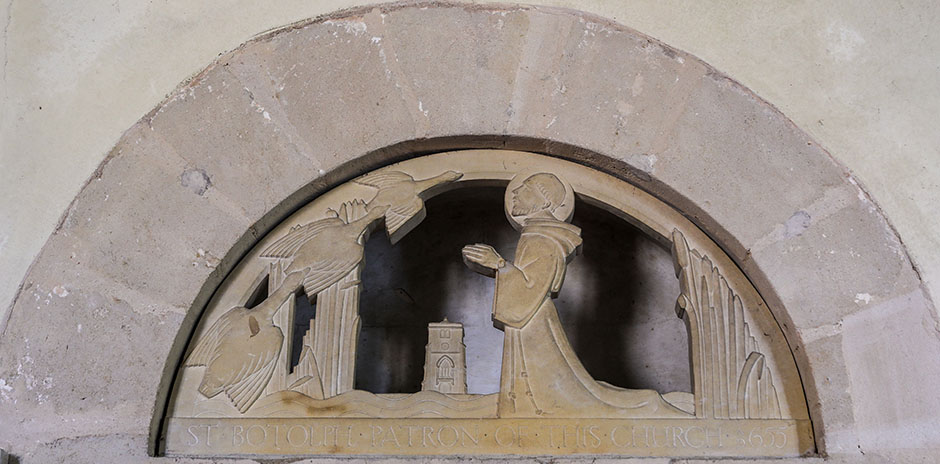
Here we see the interior of the South door, with its basic shape reflecting the Saxon cum Norman arch we looked at earlier in the Porch. The round arch is now filled with a piece of sculptured atone. We will take a closer look at that below.

This is the Arch in the North wall, only discovered during repairs around the 1980s. The dilapidated brickwork arch was re-constructed to the Tudor shape that it appeared to have been when hidden, presumably in the 1860s.

This is a close look at the carved stone in the interior Lunette (or Tympanum) of the South doorway that we saw earlier in the Porch. Underneath it is inscribed "ST BOTOLPH PATRON OF THIS CHURCH AD 655". The AD 655 refers to the date when Botolph founded the Monastery of Icanho in Suffolk. This is now known as Iken, an incredibly wet and marshy area near Aldeburgh. The monastery was totally destroyed by Danish invaders in 870, but the present church has a section of a Saxon Cross possibly made in memory of St Botolph. There were eventually around 70 churches dedicated to St Botolph, including Bradenham. This sculpture shows the Saint in front of the tower of Bradenham church, even though it was not built until nearly 700 years after the Saint's death around 680. The geese, reeds and bullrushes in the carving reflect the marshlands in which Botolph chose to build his monastery, close to the River Alde in Suffolk. This stone was sculpted in 1935, in the style of Eric Gill's work, Gill lived only two miles from Bradenham. Surrounding the stone, the geese, reeds and bullrushes obviously reflect the marshland around the site of Botolph's monastery.
Go up page to INDEX

The font is in the corner of the tower, and to me obviously dates from Street's restoration work in the 1860s. Street often produced very plain but very solid fonts.

The Nave Roof also looks very much like Street's work, which would again date it from the 1860s.
Go up page to INDEX

The Chancel Screen has a very medieval theme but it was all fitted in the 20th century, in stages. Firstly the 5 bay timber screen and the Pulpit were made as a memorial to Rev John Graves, rector at Bradenham from 1865 to 1900. The work was completed in 1902. The metal grill and three gates were added around 1980, donated by a churchwarden, Frank West. They were made at the forge in Loosley Row.

The Rood Loft was added onto the Screen in 1927. It is believed to have come from another church, but it is not known where that was. If you look at the 2 ends, they do not match, showing it has probably been adapted to match the space. A plaque on the wall says that it was erected in memory of Ursula Hughes by her brother Rev Octavius Hughes (Rector 1923-1939) and her sister Caroline. However, Mrs Tempest of Bradenham Manor also seems to have been involved with the provision or installation of Loft and Rood figures.
Go up page to INDEX

The Rood figures on the rood Loft are the crucified Christ, flanked by his mother Mary, and the disciple John. The Chancel Arch itself, the top of which is behind the figures, is part of Street's work of the 1860s. It replaced what has been described as a fine old Norman Arch, which had similarities to the South Doorway.

A closer look at the pulpit of 1902. Behind the Pulpit, the iron bars filling the right hand arch of the screen are actually a gate, allowing access to the pulpit. Notice the recess in the wall on the extreme right.

The Recess is a very small Piscina, showing there was a medieval Nave Altar here. Like the Tudor arch in the North wall, it was only discovered in the 1980s during plasterwork repairs.
Go up page to INDEX

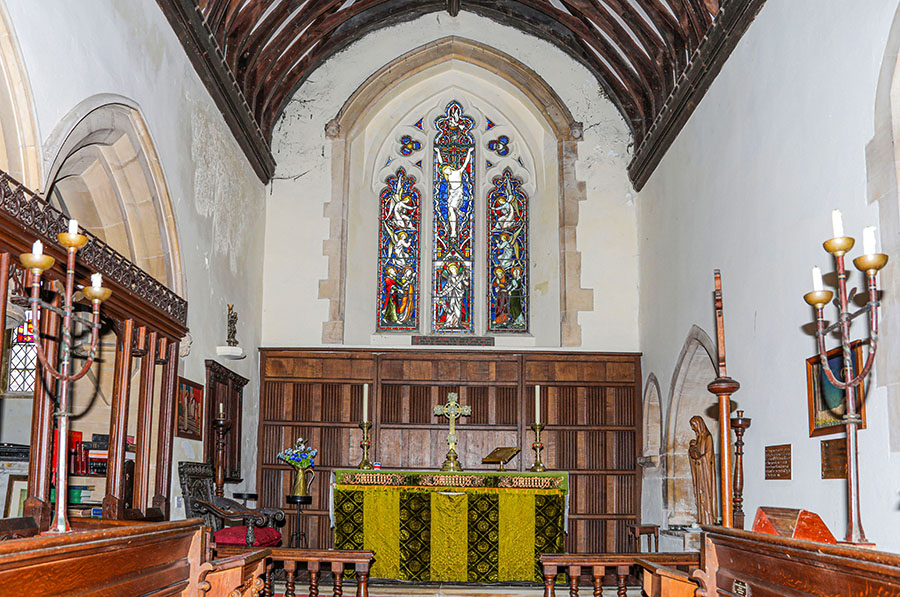
The interior of the Chancel, remembering that the whole Chancel was rebuilt as part of George Edmund Street's restoration work in the 1860s.

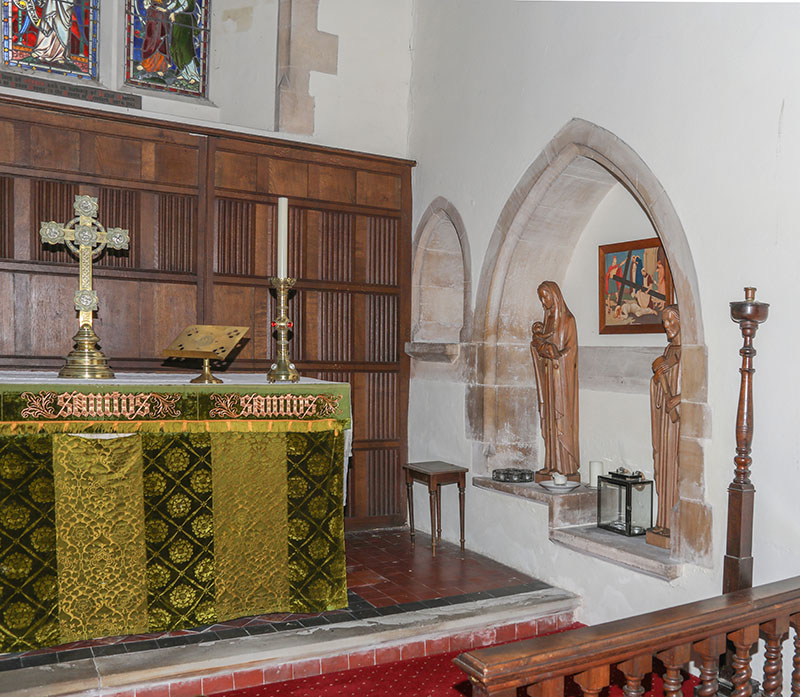
By reports of the earlier furnishings, we can assume that Street rebuilt the Piscina and Sedile in the South Wall, but some original parts may have been re-used.
Go up page to INDEX

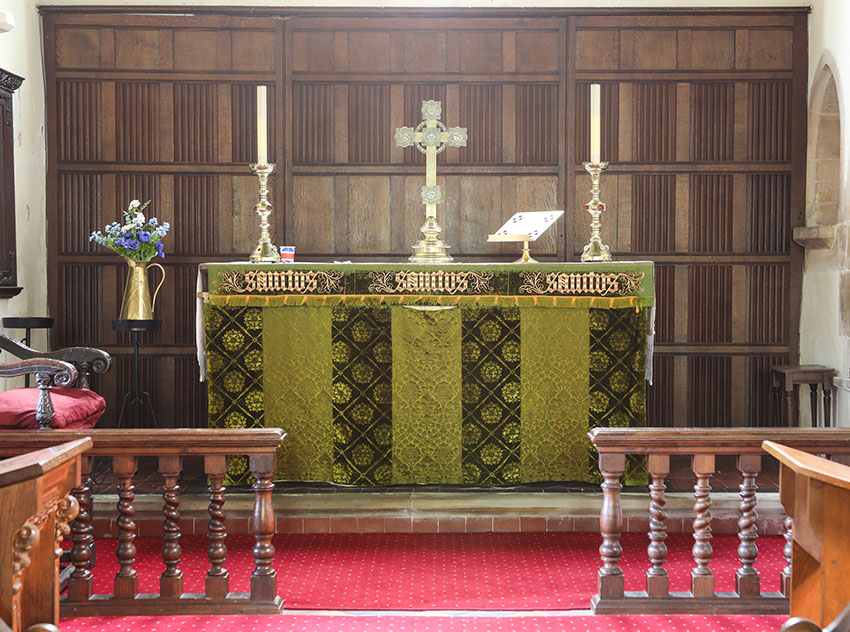
It is reported that Canon Vernon Stanley (a very accomplished woodworker and Rector of Ickford from 1911-1933) made these Communion Rails at Bradenham. I suspect he also made some of the other items, but otherwise most of the rest of the woodwork in the Chancel is thought to date from the 1860s restoration work. One exception is the Altar, which as one would expect, is usually covered.

However, here I have been able to photograph the Altar itself, which is obviously an extremely solid piece of woodwork. I understand that when it needs to be moved, the massed strength of the village cricket team has to be used. It was donated by Edward Lambeth in 1742. His large listed monument is in the churchyard, that he shares with his father John, and can be seen on Page 3 herein.

These are attractive doors on the old Aumbry in the North Wall. An Aumbry was basically a cupboard near the Altar for valuables and vessels, this one looks exceptionally large. Although many Aumbries have survived, it is quite unusual to see one still fitted with doors of any age.
Go up page to INDEX
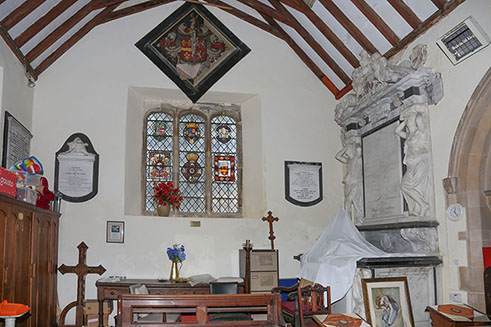
Below are two interior views of the 1542 Chapel, which is now used as the vestry. Details of the monuments and heraldic glass can be seen on other pages of this website.

Looking East to the window with heraldic glass, with the "Charles and Elizabeth West monument" on the right.

Looking West to the chapel's original private entrance door. When Street added the arches on the left, the Lord of the Manor's pew was where the organ is now.
Historic Churches of Buckinghamshire
All photographs by Michael G Hardy unless stated otherwise