Historic Churches of Buckinghamshire
St Botolph, Bradenham
Denomination: | C of E - Wycombe Deanery |
Local Authority to 2020: | Wycombe District Council |
Local Authority UA: | Bucks UA (North West Chilterns) |
Building Location: | The Green, Bradenham (3 miles NE of High Wycombe) |
Nearest Post Code: | HP14 4HF |
O/S Map Reference/NGR: | SU 82825 97126 |
Latitude & Longitude: | |
CofE ACNY Web Site: | |
Other Web Site Links: | |
For details of this church on our "Stained Glass of Buckinghamshire Churches" website, please click here
| Notes on Stained Glass: | Bradenham has windows of the Victorian era by 4 different makers, as well as Heraldic Glass from the 16th and 18th Centuries, although that is not normally accessible.
|
|
| Introduction to Church: | St Botolph's Church has origins from the very early Norman period, with an intriguing South Doorway. Indeed the whole Nave maintains its narrow character from the 11th Century. The W Tower was added in the 15th Century, and an important addition was made to the North of the Chancel in 1542. It was a large Chantry Chapel, and was very likely the last Chantry Chapel to be built in England. More... The Chantry Chapel (now a Vestry) contains a spectacularly large monument to Charles West who died in 1684. George Edmund Street restored the church in the 1860s rebuidling the Chancel and the Chancel Arch, together with the Nave windows.
|
| Notable Features: | | Norman | S Doorway (with Saxon style elements). |
| Perp | W Tower. |
| †1521 | Brass - Richard Redberd |
| 1542 | Chantry Chapel, built by Lord Windsor. |
| 1684 | Monument - Charles West. Sculptor was Edward Stanton. (Upper part of monument is possibly by Stanton). |
| †1848 | Monument - Isaac D'Israeli |
| 1863 & 65 | Restoration. Architect was George Edmund Street. |
| 1865 | Font - a typical plain but solid font by Street. Designer was George Edmund Street. |
| 1927 | Chancel Screen & Rood Loft. |
| early 20C | Communion Rail. Designer was Canon Vernon Staley. (Staley was Designer & Maker). |
| 20C | Sculpture of St Botolph. Over the interior of S Door, done in the style of Eric Gill. |
|
An Illustrated Article about St Botolph's Church, Bradenham - Page 3 of 4
Index of Main Topics Included:
Monuments - Introduction
Bradenham Church and the Lords of Bradenham Manor have always had close ties, and that is very evident in many of the monuments in the Chantry Chapel that was added in 1542. Over 9 centuries there have been over 40 Lords of the Manor at Bradenham, with about 12 different family names, although some were related to their predecessors. The church contains monuments to people with some of those family names between the 17th and 20th centuries. Below, I have included some of the monuments, with some relevant family details added.
WINDSOR Family ~ 1505-1642
A John Scott had been at Bradenham for 1435 until he died in 1500. In 1505 his heirs sold the Manor to Andrew Windsor, who was knighted at Henry 8th's Coronation in 1509, and created a Baron in 1529. At the time of the Domesday Book, one of Andrew Windsor's ancestors was Constable of Windsor Castle, which led to the family being able to use the name Windsor. Bradenham has no Windsor family monuments, but we start with a Rector appointed in 1513 by the 1st Lord Windsor, 8 years after he purchased the Manor.
Rev Richard Redberd - Rector 1513-1521
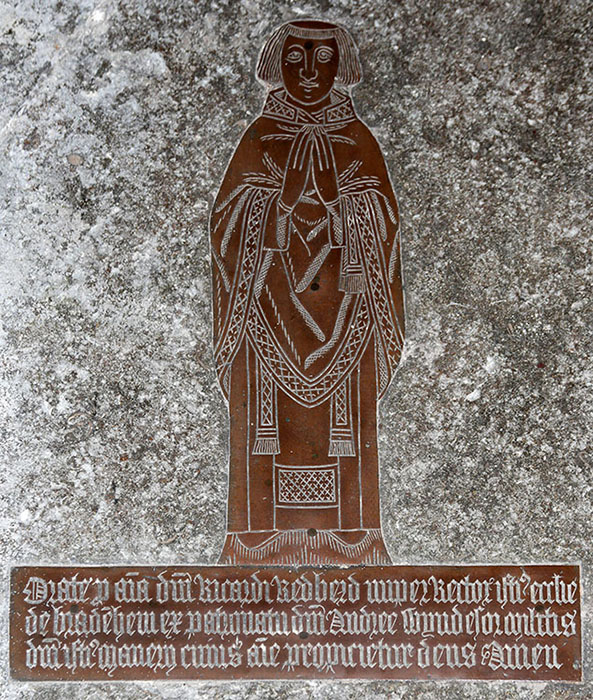
This small brass is in the Chancel, and shows the Rector of Bradenham from 1513 to 1521, who died 3 years before the Chantry Chapel was built. He was the Rev Richard Redberd, portrayed in his Mass Vestments.

The inscription tells us that he was appointed as Rector by Andrew 1st Lord Windsor.
Go up page to INDEX
Chantry Chapel (now Vestry), built 1542.
The Bradenham Chantry Chapel was built in 1542 by the 1st Lord Windsor's son, William, who had taken over his father's Parliamentary seat of Chepping Wycombe in 1529 when his father had been created a Baron. The 1st Lord Windsor died in 1543, and was succeeded by his eldest son William, as 2nd Lord Windsor. The Chapel had a long Latin inscription around the cornice of the ceiling describing its origins, which is sadly now lost. Over nearly 500 years the Chapel has been known by many different names, such as a Chantry Chapel, the Windsor Chapel, a Mortuary Chapel, a Burial Chapel, the Patron's Chapel, the Patron's Aisle, or just a Chapel. After being opened up with 2 arches into the Chancel by Street, it housed a 4 seat family pew for the Lord of the Manor, where the organ is now. The Chapel also had benches for 36 children. It is now known as the Vestry, but contains one vast monument, as well as others, related to the families at the Manor.
Whether the Chapel was ever actually established as a Chantry, which would need to have been endowed with funds to maintain its own priest, is impossible to say, as Chantries were abolished by King Henry 8th with two acts in 1545 and 1547, something that was effectively all part of the Dissolution of the Monasteries.

The East walls of the Chancel and Chapel, showing that the Chapel is much wider then the Chancel.

The Chapel seen from the North West, with 2 windows facing North.

This is the West wall of the Chapel, with its private entrance door.

This small plaque is in the very centre of the wall (see photo on left). It shows a Stag's head as the Windsor Crest.
William Windsor had succeeded his father as 2nd Lord Windsor in 1543, the year after he started to build the Chantry Chapel. He then soon started rebuilding the Manor House in a Tudor style, probably in the traditional shape of an E. The Manor then passed through to the 3rd, 4th, 5th, and 6th Lord Windsor's. The last was Thomas, who died in 1605 but had no family, so the estate had to be sold around the time of the Civil War. None of the Windsor's seem to have had monuments at Bradenham but they had another Manor at Hounslow, where they were buried, until that property was sold by the 3rd Lord Windsor.
Go up page to INDEX
PYE, LOVELACE and WENTWORTH families ~ 1640s-1787
Between 1642 and 1649 Bradenham Manor was purchased by Sir Edmund Pye, however it was soon destroyed by fire during the Civil War. Pye started rebuilding the house but he died in 1673, leaving his wife Catherine and 2 daughters. The eldest, Martha and her husband Sir John 3rd Baron Lovelace, completed the rebuilding of the Manor House. Sir Edmund Pye's younger daughter, Elizabeth had married the Hon Charles West but he died in 1684 at the age of 39, and she died in 1713 at the age of 73. It is Charles and Elizabeth West that are remembered in what is by far the largest and most memorable monument at Bradenham.
Charles and Elizabeth West Monument (1684 and 1783)

The complete monument, which is the height of the wall.
This is an important and unusual monument with Caryatids supporting the Entablature instead of columns. That is rare, but it is exceptionally rare to have one male Caryatid as they were usually female. Katharine Esdaile, an acknowledged expert on Renaissance Monuments wrote in the Records of Bucks (p34, Vol 15, 1947) that she is certain the Master Mason who made this monument was William Kidwell, whose work is rare but always accomplished. However, there are also claims that the upper parts of the monument were the work of Edward Stanton.

The upper part of the monument with a long inscription and elaborate entablature. (NB - entablature refers to all the various parts of the top of the monument that rest on the side columns, or caryatids in this case.)
Go up page to INDEX

Inscription to Charles West, died June 22, 1684, aged 39.

Figures in the form of Caryatids support the entablature above. Originally Greek, Caryatids were nearly always female figures, taking the place of plain columns. This pair look very relaxed about carrying the great weight of the elements of the entablature on their heads.

The unusual left hand male Caryatid at Bradenham.

The more conventional right hand figure of a female at Bradenham.
Go up page to INDEX

The complete Entablature.

The complete West family achievement on top of the monument. This includes the Coat of Arms, with Helmet, Crown and Crest on top, with the family motto below, and a pair of Supporters, with one on each side, against a background of foliage decoration.
Go up page to INDEX

The large table tomb at the base of the Monument.

The inscription on the front is for Elizabeth West, who was the second daughter of Sir Edmund Pye. She died at the age of 73 in 1713, 29 years after her husband, Charles West.
The Charles and Elizabeth West Monument backs onto the North wall of the Chancel, and is large by any standard, particularly for a small village church. It is perhaps even more surprising to find it is not in memory of somebody who was actually a Lord of the Manor. All subsequent monuments were far more modest wall tablets.
Elizabeth West's elder sister Martha had introduced the Lovelace and Wentworth titles into the history of Bradenham Manor, and they continued for another 3 generations, although there are no monuments that show them. In 1787 Thomas 2nd Viscount Wentworth (and 10th Baron Wentworth) sold the estate to John Hicks. Monuments of the 19th and 20th century Hicks and Tempest family are shown on Page 4.
Go up page to INDEX
1745 Lambeth Monument
This family was not connected to Bradenham Manor.
This monument is included as it is the largest in the churchyard and is Grade II listed. It is a large elaborate tomb chest which remembers two of the Lambeth family, father and son. They are recorded as having been benefactors of the church. It is certainly known that they donated the very substantial altar table, which is shown on Page 2 herein. Another 4 of the Lambeth family have graves in the churchyard, they died between 1714 and 1746. At least some of the family were Haberdashers in London.

This South side of the Monument (facing the Manor wall) has its main panel inscribed to Edward Lambeth who died in 1746. The inscription is dificult to read, and says the following:
HERE LIES THE BODY OF MR EDWARD
LAMBETH, CITIZEN AND HABERDASHER
OF LONDON, SON OF EDWARD AND
CATHERINE, HUSBAND OF FRANCES
AND FATHER OF JOHN LAMBETH
AFORESAID WHO DIED SEP 16 1746
AGED 64 YEARS

This North side of the Monument (facing the Chancel) has its main panel inscribed to John Lambeth who died in 1745, the year before his father, Edward.

Although this inscription is slightly easier to read, it is shown here:
HERE LIES THE BODY OF MR JOHN
LAMBETH ONLY SON OF MR
EDWARD LAMBETH AND FRAN
HIS WIFE WHO DIED ON NOVEMBER
THE 25th 1745 IN THE 36th YEAR OF HIS
AGE
Go up page to INDEX or TOP
Historic Churches of Buckinghamshire
All photographs by Michael G Hardy unless stated otherwise
©2017-2026 Michael G Hardy
